


You’ve been doing the same things you always did. Same walks, same weekend hikes, same reasonably careful eating.
And somewhere in the last two years, the results stopped matching the effort. The scale moved the wrong way. Your shoulders ache in the morning. Recovery takes longer than it used to.
Most people around you keep suggesting more cardio. More steps. More restriction. None of it moves the needle.
That advice isn’t working, and it isn’t your fault. The rules changed underneath you, quietly, and nobody handed you the new ones.
Strength training for menopause is one of the few things that directly addresses what’s actually shifting. Not as a fix. As a lever. What changes in this window is specific, and so is what you can do about it.
Why Strength Training for Menopause Matters More Than Cardio
Cardio isn’t the problem here, but it isn’t the answer either.
Steady-state cardio does good things for your heart and your head. What it doesn’t do reliably is give your body a reason to keep muscle and defend bone. Those two tissues respond to load, and mostly to load.
Most people in this window already do plenty of cardio and almost no meaningful resistance work. So the input that matters most for body composition is the one that’s missing.
Resistance training asks something specific of you. Move a real load, with control, close to the edge of what you can currently do. That signal is what muscle and bone tend to respond to, in most cases, at any age.
So the goal shifts. Less about burning something off. More about giving your body a reason to hold onto what you’ve already got.
What Happens to Muscle and Bone as Estrogen Declines?
Estrogen does far more in the body than most of us were ever taught.
Among other roles, it’s involved in how muscle tissue is maintained and how bone remodels itself over time. As levels decline through perimenopause and into menopause, that support tends to thin out. Muscle gets harder to hold. Bone density is often affected too.
This is why body composition can drift even when nothing about your habits changed. The inputs stay the same and the output quietly stops matching them.
Resistance training is one of the more useful inputs during this stage, and it tends to sit alongside whatever else you and your doctor decide is right. Broad clinical guidance generally includes strength work here.
None of that promises an outcome. It just means the lever exists, and most people aren’t pulling it. This is general education, not medical advice, so bring your own history to a doctor who knows it.
Is Perimenopause Strength Training Different From Regular Lifting?
Yes and no, and the difference is smaller than most people expect.
The principles don’t change. You still need real load, progressive over time, applied to the movement patterns that matter, which means pushing, pulling, hinging and squatting.
What changes is the margin for error. Perimenopause strength training rewards precision more than volume, because the recovery cost of sloppy, high-impact work climbs. You can still train hard. You just can’t train carelessly.
At LUX Fitness in Franklin, the correction is almost always subtraction. Someone arrives convinced they need to do more, and what actually helps is doing less of the wrong thing with far more attention on the part that counts.
That’s the whole shift, really. Not a different sport. Just a tighter version of the same one. If you want the wider picture first, here’s how we approach strength training for women in Franklin generally.
Why Recovery Needs Change During This Window
The training is only half of it, and the other half gets harder around now.
Sleep quality often shifts during perimenopause, sometimes considerably. Less deep sleep usually means less complete recovery, so the next session lands on tissue that isn’t ready. Do that repeatedly and training starts to feel like punishment instead of progress.
Most people respond by training more. That’s usually backwards. Two focused sessions a week that you fully recover from tend to beat five you never quite absorb.
This is also why session frequency at LUX is deliberately low. Thirty minutes, roughly twice a week, is enough stimulus for most people without stacking fatigue you can’t clear.
Recovery isn’t the reward for training. In this window, it’s part of the training.
Can You Still Train Hard When Your Joints Ache?
Usually yes, though probably not the way you did at twenty-five.
Aching joints are common at this stage and there can be several reasons for it. Practically, the ache tends to come from impact and from load your body wasn’t braced for, not from effort itself.
Adaptive resistance, the technology we use at LUX, is worth understanding here. ARX matches resistance to the force you produce, rep by rep, so there’s no dropped weight, no momentum, no bar crashing down on a joint at the worst moment. Smooth motion. Low impact. No pounding.
That means you can work at genuinely high effort while the mechanical stress on the joint tends to stay controlled. For a lot of people, that’s the difference between training consistently and quitting after six weeks.
Effort and joint stress aren’t the same thing, and separating them changes what’s possible. If achy joints are your main hesitation, that separation is usually the thing that makes training sustainable again.
What Strength Training for Menopause Looks Like at LUX in Franklin
It looks quieter than you’d guess.
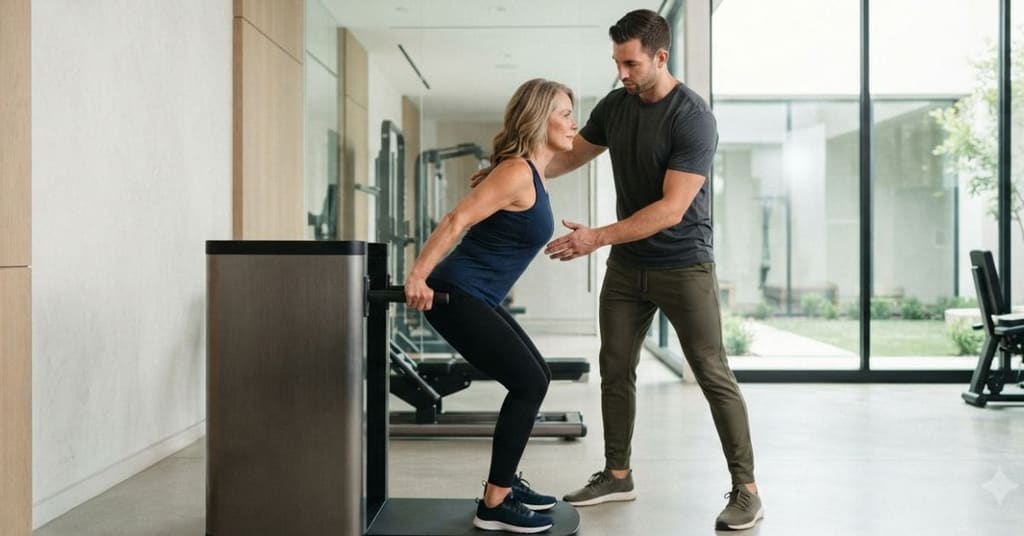
You book a time. You walk into a private studio with no crowd, no waiting, nobody watching. A coach takes you through a short sequence of controlled movements, and the machine records what you produced on every rep.
That last part matters more than it sounds. Instead of guessing whether you’re getting stronger, you have load data. Objective, tracked, session over session. On a week when you feel terrible, the numbers can tell you whether that’s real fatigue or just a rough mood.
Sessions run about thirty minutes, roughly twice a week, on your schedule. No filler. No warmup that quietly becomes the workout.
That’s it. Not a program you have to believe in. A process you can check.
Frequently Asked Questions
Should I start strength training if I'm already on hormone therapy?
That’s a question for the doctor managing your care. In general, strength work and medical treatment tend to address different things rather than competing, so most people can do both, but the sequencing should come from whoever knows your history.
Do I need a bone density scan before I start strength training?
That’s a decision for your doctor, not a prerequisite for training. Most people can begin controlled resistance work without one. If you already have a diagnosis affecting your bones, bring it to your coach so loading can be adjusted.
Is it too late to start if I'm already postmenopausal?
No. Meaningful strength gains appear to be possible at every stage of adult life, including well after menopause. Starting later usually means being more deliberate about progression and recovery, not doing less. Your doctor can flag anything specific to your situation.
Do I need to change how I eat for this to work?
Not necessarily, and we don’t coach nutrition here. Most people see progress from the training itself. If food becomes a real question for you, a registered dietitian or your own doctor is the right place to take it.
What if hot flashes or poor sleep make sessions unpredictable?
That’s normal and it’s workable. Because sessions are appointment-only and short, they’re far easier to keep on a rough week than an hour-long commitment. Tell your coach what kind of night you had, and the session gets adjusted to it.
Train Through Menopause at LUX Fitness in Franklin, TN
Nothing about this stage means you’re on the way down. It means the inputs that used to work by default now have to be chosen on purpose, load tracked and recovery respected. If you’re exploring what that looks like, you can book a free intro session and see the process. Many women also ask whether strength training makes women bulky.