

How Sleep Affects Muscle Recovery and Strength Gains

Ben Cluff
Ben Cluff
It’s 5:45 and the parking lot is already full. Inside, twenty-two people are lined up on mats while someone counts down from ten over a speaker.
You find a spot near the back. The person beside you is half your age and moving twice as fast.
Forty-five minutes later you’re soaked, your heart rate is high, and you have no idea whether you got any stronger. Maybe. Probably? Hard to say.
That uncertainty is what sends most people looking up personal training vs group fitness in the first place. Both formats work for someone. They just don’t work the same way, and the difference matters more than the price gap suggests. Here’s where each format actually wins.
What Actually Separates Personal Training and Group Fitness
The difference isn’t intensity, it’s who the session is designed around.
Group fitness is designed around the room. One session, one plan, delivered to whoever shows up that morning. That isn’t a flaw, it’s the format working as intended, and it’s what keeps the cost down and the energy high.
One-on-one training is designed around one person. The load, the pace, the exercise selection and the stopping point all belong to you.
Most people compare the two on price and intensity, which are the two easiest things to measure and the two least predictive of whether you get stronger. Which one is right for you? It depends less on the format than on what you need from it, so let’s compare attention, load, tracking and control.

How Much Coaching Attention Do You Actually Get?
In a group, attention gets divided by the number of people in the room.
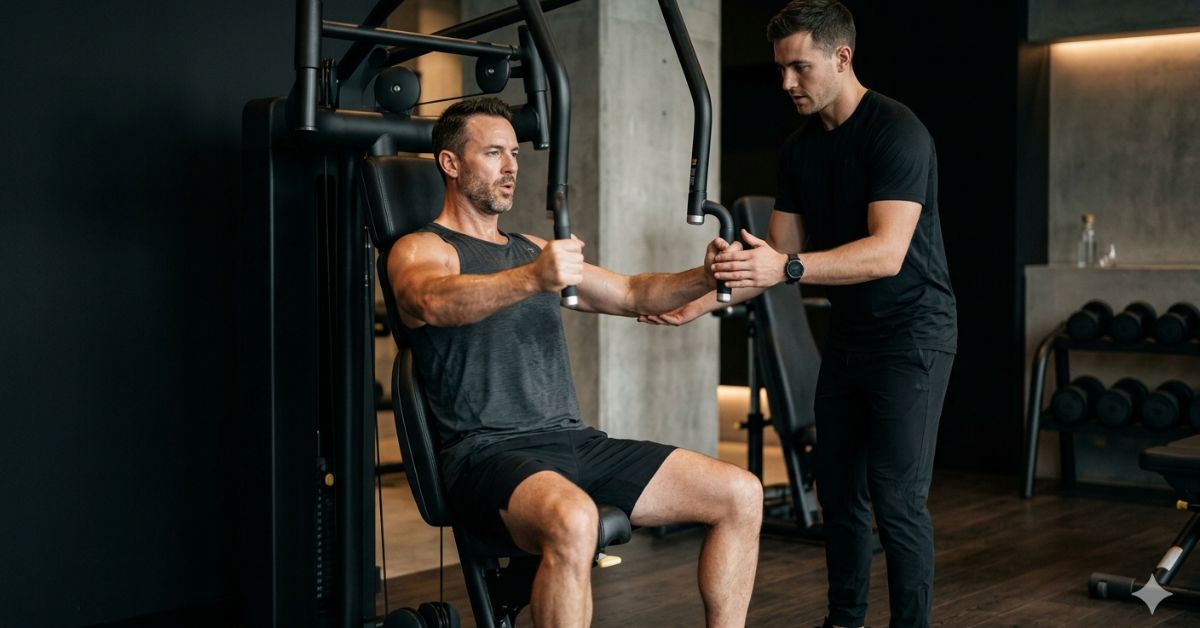
That’s arithmetic, not criticism. A good instructor is watching form, cueing, scaling on the fly and keeping the session moving. Split across a full room, though, most of what you do goes unwatched. You get corrected when something looks obviously wrong, not when it’s subtly off.
Subtly off is where most progress leaks out. A hip that shifts. A rep that gets fast at the end. Small things a coach standing three feet away catches immediately and a coach managing twenty people simply can’t.
At LUX Fitness, the pattern surfaces within the first few sessions. Someone who has trained in a group setting for years finds out that one side has quietly been doing more of the work than the other.
Is the Load Matched to You or to the Room?
In a group setting, the load is something you pick yourself.
That’s the part nobody says out loud. Whatever the instructor calls out, the actual weight is a guess you make in the moment, usually calibrated to what you did last time or what the person beside you grabbed. Sometimes that guess is good. Often it’s conservative, because nobody wants to stall out a lift in front of a room.
One-on-one, load stops being a guess. On ARX, adaptive resistance technology that pushes back with exactly the force you apply, resistance matches your output on every single rep. Not the average of the room. Yours.
That matters most at the edges. The last few reps, where adaptation tends to happen, are the ones a self-selected weight almost always undersells.
How Does Progress Get Tracked in Each Format?
Group fitness tends to measure the session, while one-on-one measures you.
Calories, heart rate, how tired you felt afterward, those are session metrics. They tell you something happened. They don’t tell you whether you’re stronger than you were in April.
Objective load data does. Force output per rep, session over session, is a straight answer to the only question that really matters, is this working. It also catches plateaus early, while they’re still easy to correct.
Most people are surprised by how much the tracking changes their behaviour. When progress is visible, showing up stops being a discipline problem. If you want to see how that works inside a session, here’s how a coached ARX session actually runs from start to finish.
Who Controls the Schedule?
A class happens when it happens.
For some people that’s the entire appeal. A fixed time on the calendar, non-negotiable, is the thing that gets them out the door. If that’s what makes you consistent, it’s a real advantage and worth protecting.
For a lot of professionals, though, it’s the exact reason they stop going. The six a.m. slot conflicts with an early call. The evening session starts twenty minutes before you leave the office. Miss enough of them and the membership quietly turns into something you pay for and don’t use.
Appointment-only training moves with you instead. Thirty minutes, booked around your calendar rather than against it, twice a week. Private, by design. No waiting for equipment and no audience.
So Which One Gets You Stronger?
For building measurable strength, one-on-one wins on the four things that decide it.
That isn’t a knock on group fitness. It’s social, it’s usually cheaper, and the fixed schedule is genuinely useful for people who need external structure. If you like the room and it keeps you showing up, keep going.
But if you’re short on time and tired of not knowing whether any of it is working, the calculus changes. You don’t need more energy in the room. You need load matched to you, someone watching every rep, and numbers that tell you where you stand.
That’s the case for one-on-one, and it’s the reason the format exists at all. If you want the full picture, here’s what one-on-one training involves week to week.
Frequently Asked Questions
Should I start strength training if I'm already on hormone therapy?
That’s a question for the doctor managing your care. In general, strength work and medical treatment tend to address different things rather than competing, so most people can do both, but the sequencing should come from whoever knows your history.
Do I need a bone density scan before I start strength training?
That’s a decision for your doctor, not a prerequisite for training. Most people can begin controlled resistance work without one. If you already have a diagnosis affecting your bones, bring it to your coach so loading can be adjusted.
Is it too late to start if I'm already postmenopausal?
No. Meaningful strength gains appear to be possible at every stage of adult life, including well after menopause. Starting later usually means being more deliberate about progression and recovery, not doing less. Your doctor can flag anything specific to your situation.
Do I need to change how I eat for this to work?
Not necessarily, and we don’t coach nutrition here. Most people see progress from the training itself. If food becomes a real question for you, a registered dietitian or your own doctor is the right place to take it.
What if hot flashes or poor sleep make sessions unpredictable?
That’s normal and it’s workable. Because sessions are appointment-only and short, they’re far easier to keep on a rough week than an hour-long commitment. Tell your coach what kind of night you had, and the session gets adjusted to it.
Train Through Menopause at LUX Fitness in Franklin, TN
Nothing about this stage means you’re on the way down. It means the inputs that used to work by default now have to be chosen on purpose, load tracked and recovery respected. If you’re exploring what that looks like, you can book a free intro session and see the process. Many women also ask whether strength training makes women bulky.