

Best Time of Day to Workout: Why the Clock Matters Less Than You Think

Ben Cluff
Ben Cluff
Your calendar has three openings this week.
One at 5:50 in the morning, before anyone in the house is up. One at noon, wedged between two calls. One at 7:15 at night, when the day has already taken what it wanted.
None of them feels obviously right. So you keep waiting for the version of the week where a cleaner slot appears, and another week goes by.
It’s a fair thing to wonder about, and there’s real physiology underneath it. Your body genuinely doesn’t perform identically at every hour of the day.
But the best time of day to workout is rarely the one people actually end up needing. Here’s what the timing question really turns on, and what tends to matter far more.
What Actually Changes in Your Body Across the Day
Your body runs on a daily rhythm, and strength output rides along with it.
Core body temperature tends to sit at its lowest in the early morning and climb through the afternoon. Warmer muscle is generally more pliable, and coordination often feels sharper later on. That’s a big part of why so many people report feeling more capable after lunch.
Hormones shift too. Cortisol is typically highest shortly after waking and drifts downward as the day goes on. These patterns are generally described as ordinary daily variation rather than something you’re meant to manage.
The differences are real. They’re also smaller than the internet suggests, and they vary quite a bit from person to person.
So the clock does something. It just doesn’t do nearly as much as people hope it will.
Is Morning the Best Time to Lift Weights?
For a lot of busy professionals, yes, and it usually has nothing to do with physiology.
Mornings tend to be the most protected hours in a packed week. Nothing has gone wrong yet. No client emergency, no meeting that ran long, no text asking if you can handle pickup today.
The tradeoff is that you’ll often feel stiffer and slightly weaker right after waking. Joints take longer to loosen. Early sets can feel heavier than the numbers say they are.
Most of that fades with a proper warm-up and a few weeks of repetition. Bodies generally adapt to the hour you consistently train in.
Morning isn’t better because of your hormones. It’s better because it’s harder for the rest of the day to steal it.

Why Afternoon and Evening Often Test Stronger
If you’re chasing your best numbers, later in the day usually gives you a small edge.
By late afternoon you’ve been upright and moving for hours. Temperature is up. Joints have already been loaded, and movement tends to feel more coordinated. For many people the numbers do come in slightly higher later in the day, though the difference is modest and far from universal.
But that edge is small, and it’s easy to overvalue. A slightly better session you attend two-thirds of the time is worth less than a slightly worse one you never miss.
There’s a practical problem too. Evenings are the least defensible part of most calendars. Dinner, kids, one late request, and the plan quietly moves to tomorrow.
A performance edge you can’t reliably show up for isn’t much of an edge.
Does Training in the Evening Hurt Your Sleep?
For most people, no, though it depends on the person and on how close to bed you finish.
The old advice was to avoid anything hard at night. More recent guidance is considerably softer, and many sleep researchers now suggest evening exercise doesn’t disrupt sleep for most adults.
What matters more is intensity and proximity. Finishing a demanding session minutes before bed can leave you wired. Finishing a couple of hours out usually doesn’t.
Some people are genuinely sensitive to it. If you’re one of them, you’ll typically know within a week or two of testing it honestly.
Which is the useful move here anyway. Try the slot, watch what happens, and let your own response settle the argument. This is general education, not medical advice.
Does the Optimal Window Actually Beat Consistency?
It doesn’t, and it isn’t close.
Most people asking about timing aren’t underperforming in their sessions. They’re inconsistent, and they’re hoping a better hour will quietly fix that.
At LUX Fitness, we hear a version of this constantly. Someone tells us they train best in the evening, then their history shows the evening bookings are the ones that get moved.
The pattern is almost always the same. The theoretically optimal hour sits in the least protected part of the day. The slightly worse hour is the one that survives a hard week intact.
Pick the slot your life defends, then let the small physiological differences take care of themselves. If you’re curious what that looks like when the session is built to fit around a real calendar, here’s how 30 minute strength sessions get structured in Franklin.
How a Booked Session Removes the Timing Decision
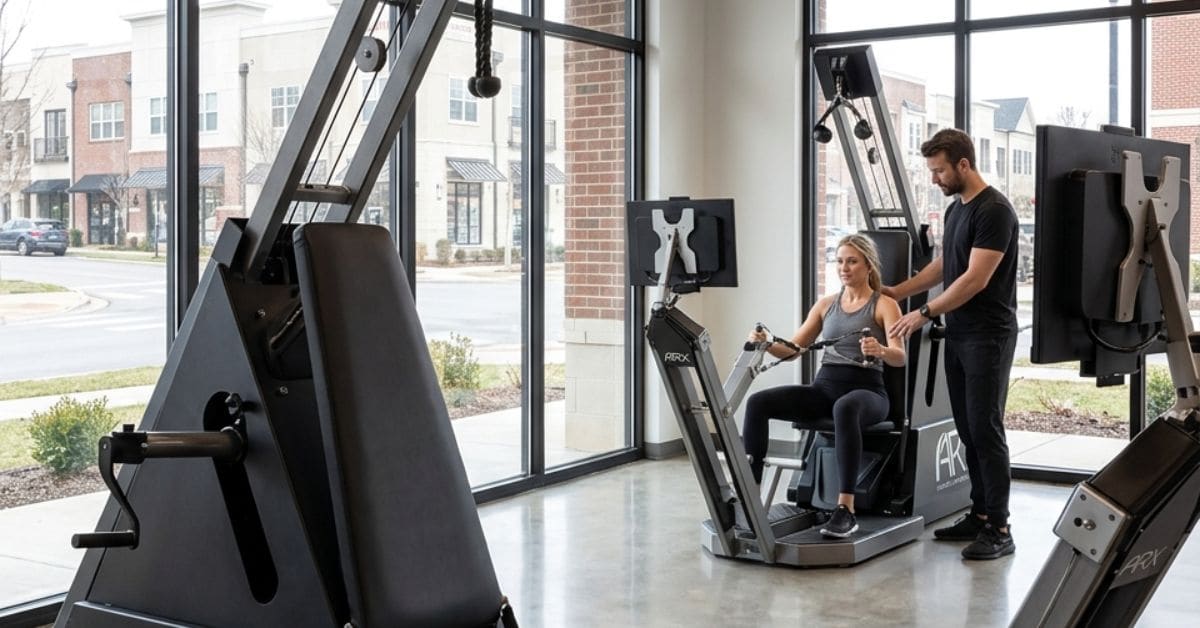
At LUX Fitness in Franklin, TN, the timing question mostly disappears once the session is on the calendar.
You book a private, appointment-only slot. It’s yours. There’s no class schedule to work around and no crowd to wait out at six o’clock.
Because the studio is appointment-only, the available windows spread across the day. Early. Midday. After work. You choose the one your week actually protects, then you keep choosing it.
The work itself is measured either way. Load data doesn’t care what time it was collected, which makes it straightforward to see whether your chosen slot is genuinely working for you.
The decision stops being “when is best” and starts being “when will I actually show up.” If you’re curious how the training itself gets measured, here’s what happens during an ARX workout for people training in Franklin.
How to Find a Personal Trainer in Franklin
Should you eat before an early morning strength session?
It depends on the person. Some people train perfectly well on an empty stomach early, and others feel flat without something small first. Neither is required. Try both for a couple of weeks and keep whichever leaves you steadier under load.
How long should you warm up if you train first thing?
A little longer than later in the day. Muscles and joints are generally cooler and stiffer after waking, so a few extra minutes of easy movement usually helps. Nothing deep. Just enough to raise temperature and restore range.
Is it a problem to train at different times each week?
Not necessarily, though a fixed slot tends to hold up better. Varying times can work fine as long as the session still happens. For most people, a repeating appointment removes the daily negotiation about when to fit it in.
Does the best time of day to workout change as you get older?
Not really. Older adults often report feeling better a bit later in the morning, once they’ve been moving for a while, but the underlying principle holds. The schedule you can sustain still matters more than the theoretically ideal hour.
How long does it take to adapt to a new training time?
Usually a couple of weeks. Performance at an unfamiliar hour often feels worse at first, then normalizes as your body adjusts to the pattern. Give any new slot a fair trial before deciding it doesn’t suit you.
Find Your Best Workout Time at LUX Fitness in Franklin, TN
The best hour to train is the one your week actually protects. The physiology is real, but small, and consistency beats it almost every time. Choose the slot your calendar defends, then book a free intro session to test it in a private, appointment-only setting. There’s also a look at what training just once a week can realistically do.