
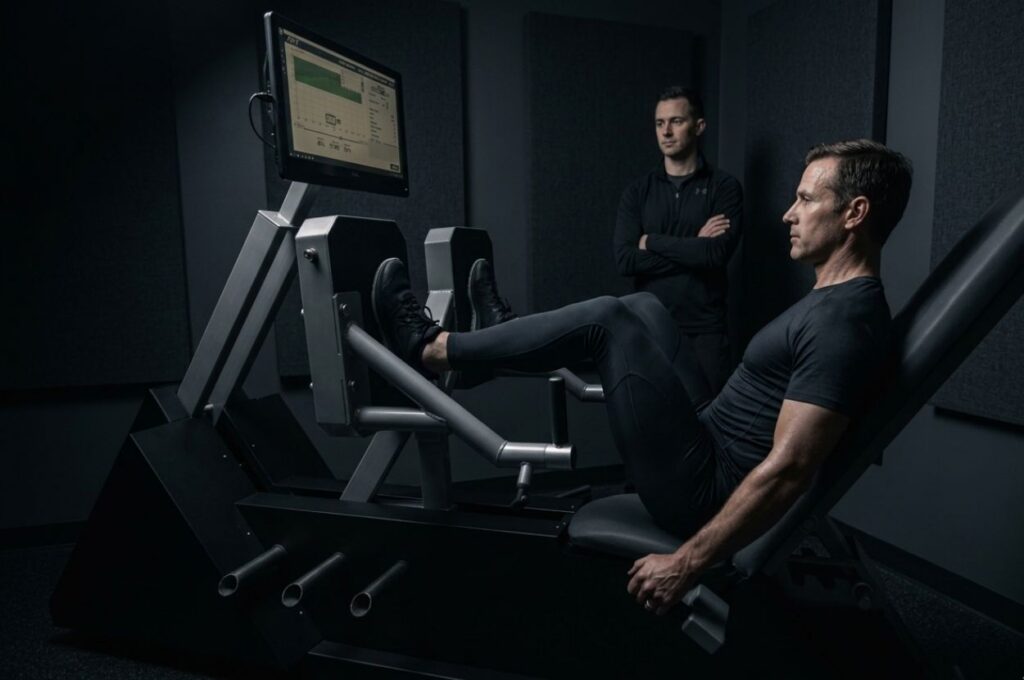

Most people have no real idea whether they’re getting stronger. They go by how a workout felt, or whether the scale moved, and hope it’s adding up to something.
That’s not a knock on effort, it’s just a blind spot most training programs never fix.
If that guesswork sounds familiar, there’s a better way to know. At LUX Fitness, ARX measures your strength directly, turning every session into hard data instead of a hunch.
This article explains what ARX actually tracks, why measured progress matters, and how seeing your numbers change keeps you motivated over the long haul. By the end, you will know exactly what happens behind the scenes every time you train.
What ARX Measures About Your Strength
ARX is a resistance technology that matches the exact force you produce at every point in a movement. Because the machine is reading your effort moment to moment, it can measure that effort with precision.
Each session captures your total force output and your peak force on both the pushing and lowering phases of a lift. It also logs the total work you performed.
Alongside that, it tracks rep speed, range of motion, and how your force holds up as you fatigue. All of it lands on a single dashboard that your coach reviews with you.
The result is a detailed picture of your strength that updates every time you train. Nothing is estimated, and nothing depends on how the session happened to feel.
You always know precisely where you stand, not just where you think you might be.

Why Measuring Strength Progress Matters
When progress is invisible, motivation gets fragile. It’s hard to stay committed to something you can’t tell is working.
That uncertainty is often what quietly causes people to stop showing up in the first place.
Measured strength changes that entirely. A number that climbs from one session to the next is proof, and proof is far more motivating than a vague sense of improvement.
Data also protects you from spinning your wheels. If a metric stalls, your coach can see it early and adjust before weeks of effort go to waste.
It also means you’re not the last one to notice when something isn’t working.
Just as importantly, it keeps training honest. You’re never guessing whether you pushed hard enough, because the readout tells you exactly what you did.
How Strength Progress Tracking Guides Your Training
Numbers are only useful if they change what you do next. At LUX Fitness, every session is private and appointment-based, with your ARX data directly shaping how that time is programmed.
Nothing about your plan is left to guesswork or habit.
If your force output is rising steadily, that’s a signal to keep building. If it plateaus, it’s a cue to adjust the stimulus so progress continues.
This feedback loop is what makes a single, focused 30-minute session each week so effective. Every minute of that one session is aimed at the areas the data says will move the needle.
It also means your program is genuinely yours. Rather than following a generic template, you’re training against your own measured performance, session after session.
What a Progress Review Session Looks Like
When the Review Happens
A progress review is not a separate appointment tacked onto your schedule. It happens right inside a normal session, usually in the few minutes before or after your working sets.
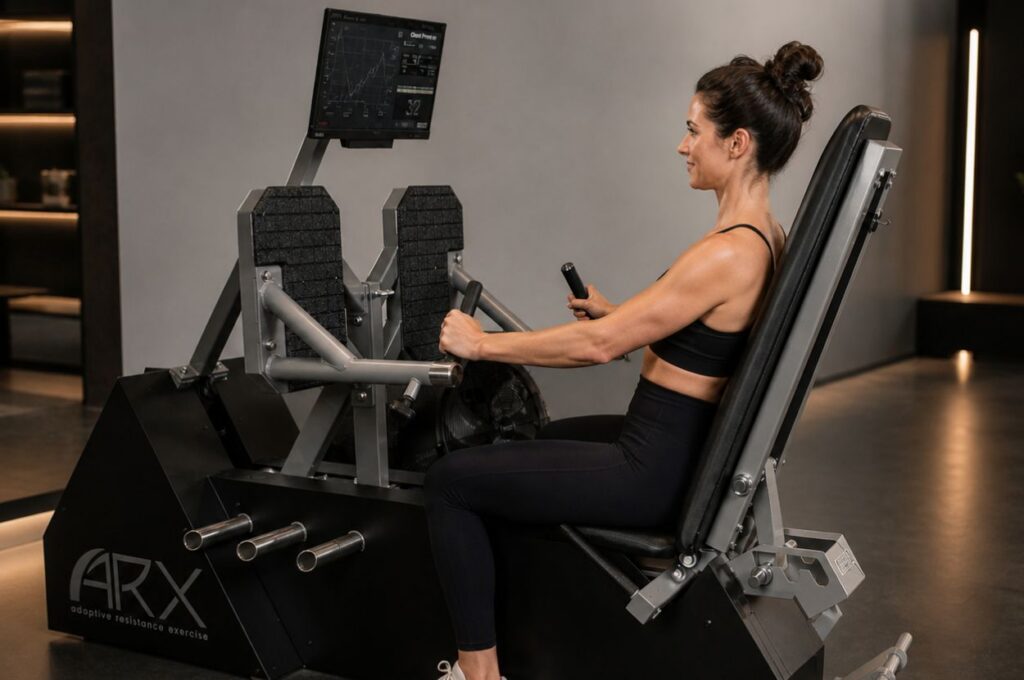
Your coach pulls up your dashboard and walks through what changed since your last visit. You will see how your force output moved, whether your peak strength climbed on a specific lift, and how your total work capacity is trending.
What Your Coach Walks You Through
These conversations stay practical rather than theoretical. If a number is climbing, your coach explains what is driving that change and how to keep the trend going in the sessions ahead.
If something has flattened out, you will hear why that might be happening and what is changing in your next few sessions to address it. Either way, you leave with a clear picture instead of a vague impression of how things are going.
Why It’s Always Current
Because this happens every time you train, there is no waiting for a quarterly check-in to find out where you stand. Your progress conversation is always current, which makes it easier to trust and easier to act on.
You also do not need to interpret the numbers on your own. Your coach translates what the dashboard shows into a specific next step, so the data always leads somewhere useful.
None of this adds extra time to your visit or turns training into a meeting. It is folded into the session you already have on the calendar, which keeps the whole process simple for anyone with a full schedule.
Seeing Progress You Can Actually Trust
Traditional workouts ask you to infer progress from indirect signals like soreness or how you look in the mirror. Those signals are noisy and easy to misread.
Objective strength data cuts through that noise. You leave each session knowing, not hoping, that you’re moving in the right direction.
That kind of specificity is hard to get from a workout that is only judged by feel.
For busy professionals in Franklin who want certainty from their time, that clarity is the whole point. Measurable progress is what turns training into a reliable investment rather than a leap of faith.
It is one less thing you have to wonder about in a schedule that is already full.

A Note From Coach Ben Cluff at LUX Fitness
“The first time someone sees their force numbers go up on the screen, something clicks,” says Ben Cluff of LUX Fitness in Franklin. “It stops being about whether they think they’re improving. They can see it, in black and white, every single session.”
“That certainty changes how people train,” he adds. “When the data confirms the work is paying off, consistency stops being a battle. The proof does a lot of the motivating for me.”
Frequently Asked Questions
How does ARX measure strength progress?
ARX matches the exact force you produce throughout each rep, which lets it measure that force precisely. It records total and peak force output, total work, rep speed, and range of motion every session, then displays it on a dashboard your coach uses to track your progress.
What strength metrics does ARX track each session?
ARX tracks total force output, maximum force on both the pushing and lowering phases, total work performed, rep speed, range of motion, and how your force changes as you fatigue. Together, these give a complete, objective picture of your strength on every visit.
Why is measurable strength progress better than how a workout feels?
How a workout feels is subjective and easy to misjudge, while measured force output is objective proof of change. Data lets you and your coach catch plateaus early, confirm what’s working, and stay motivated by seeing real numbers improve over time.
Do I need to be experienced to benefit from ARX progress tracking?
No. Because ARX matches whatever force you can produce, it works for complete beginners and experienced lifters alike. Everyone gets the same precise measurement, and beginners often find the visible progress especially motivating early on.
How often will I see my strength data?
Every session. ARX captures your metrics in real time and logs them each time you train, so your progress is always current. Your coach reviews the trends with you to guide what happens in future sessions.
Ready to Start Tracking Your Own Progress?
Strength you can measure is strength you can trust. Instead of guessing whether your effort is adding up, ARX shows you exactly what’s improving, session after session.
If you’re exploring what measurable training could look like, LUX Fitness’ strength progress tracking in Franklin offers a clear example of how data guides improvement